Get 10% OFF your first order!
Sign up for our newsletter to receive your discount code

What Is a Capsule Wardrobe and How Do You Build One?
STYLE & FASHION
6/2/20264 min read
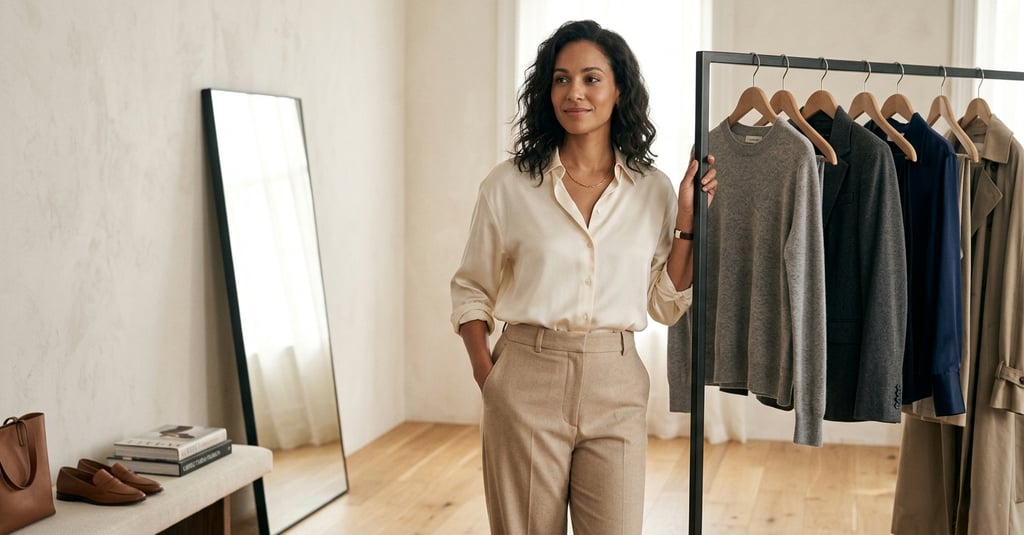

You open your wardrobe and the familiar feeling hits: nothing to wear. Not because you don't have clothes — you have plenty — but because nothing connects. Nothing feels like you. Half of it you haven't touched in months.
This is the problem a capsule wardrobe solves.
A capsule wardrobe isn't about having fewer clothes for the sake of minimalism. It's about having the right clothes — a curated collection where everything earns its place, everything works with everything else, and getting dressed every morning becomes simple, satisfying, and consistently good.
Here's how to build one from scratch.
What Exactly Is a Capsule Wardrobe?
The concept was popularized in the 1970s by London boutique owner Susie Faux, who described it as a collection of essential items that don't go out of fashion and can be supplemented with seasonal pieces.
In practice, a capsule wardrobe typically contains between 25 and 50 pieces — including clothing, shoes, and outerwear — that all work together cohesively. Every item is something you genuinely love wearing, and every possible combination creates an outfit you'd be happy to be seen in.
The result: a smaller wardrobe that feels like it contains more options, not fewer.
Why a Capsule Wardrobe Works
The psychology behind this is well established. Decision fatigue is real — the mental energy spent making small choices throughout the day depletes your ability to make larger ones. Barack Obama famously wore only grey or blue suits during his presidency specifically to eliminate this kind of micro-decision from his mornings.
A capsule wardrobe extends this logic to everyone. When everything in your wardrobe works together and you love every piece, getting dressed stops being a decision at all. It becomes automatic — and consistently good.
Beyond decision fatigue, a capsule wardrobe also: saves money over time (you buy less, but better), reduces environmental impact (fewer but longer-lasting pieces), and creates a clearer, more intentional sense of personal style.
Step 1: Define Your Lifestyle and Aesthetic
Before you buy anything or remove anything, get clear on two things.
Your lifestyle: What does your actual week look like? If you work from home, a wardrobe built around office wear doesn't serve you. If you're active and outdoors, you need different anchors than someone who spends evenings at restaurants and galleries. Your capsule should reflect the life you actually live, not an idealized version of it.
Your aesthetic: What do you want to look like? Collect visual references — from Instagram, Pinterest, people you admire — and look for patterns. Do you gravitate toward clean and minimal? Relaxed and earthy? Smart casual? Knowing your aesthetic prevents you from buying things that are beautiful in theory but wrong for you in practice.
Step 2: Audit What You Already Own
Go through everything in your wardrobe and create three piles:
Keep: Items you wear regularly, feel good in, and that align with your aesthetic. These form the foundation of your capsule.
Remove: Items you haven't worn in over a year, that don't fit well, or that feel like a different version of you. Donate, sell, or responsibly recycle.
Maybe: Items you're unsure about. Put these in a bag and store them for 30 days. If you haven't missed anything in the bag, remove it without looking inside.
Most people discover at this stage that they already own 60 to 70 percent of what they need. The audit also reveals patterns — what colors you actually wear, what silhouettes feel like you, what types of pieces are missing.
Step 3: Identify Your Gaps and Build Around Them
After the audit, you'll have a clearer picture of what's missing. This is where you shop — but intentionally, not reactively.
A well-balanced capsule typically includes:
Tops: A mix of basics and pieces with personality. Quality graphic tees, simple crew-neck tees, one or two elevated shirts. This is where a well-designed graphic tee from a brand like Leda Atelier earns its place — it's a piece with character that still works with almost everything else in the wardrobe.
Bottoms: Two to three pairs of jeans in different washes, one pair of tailored trousers, one casual shorts option for summer.
Layers: A hoodie in a neutral tone, a light jacket or blazer, a versatile overshirt. These are the pieces that make a capsule work across seasons.
Footwear: Three to four pairs maximum — clean white sneakers, a casual boot or loafer, one more formal option if your lifestyle requires it.
Outerwear: One transitional jacket, one warmer coat for winter.
Step 4: Choose a Cohesive Color Palette
The reason a capsule wardrobe makes getting dressed easy is that everything coordinates. This only works if your pieces share a color logic.
Choose a foundation of two or three neutral tones — black, white, navy, grey, camel, cream — that form the base of everything. Then select one or two "accent" tones that appear in smaller doses and add personality.
Every new piece you add should work within this palette. When it does, any top and any bottom in your wardrobe can be worn together without thinking.
Step 5: Set Rules for Future Shopping
A capsule wardrobe only stays capsule if you shop intentionally. Before adding any new piece, ask:
Does this work with at least five things I already own?
Is this something I'll still want in three years?
Does it fit the lifestyle and aesthetic I defined in Step 1?
Am I buying this because I love it, or because it's on sale?
These four questions eliminate a significant percentage of impulse purchases — the ones that end up in the "remove" pile at your next audit.
The Investment Mindset
One of the most common objections to building a capsule wardrobe is cost. Quality pieces cost more upfront. But the math, over time, almost always favors quality over quantity.
A well-made hoodie worn twice a week for three years has a cost-per-wear of almost nothing. A cheap alternative bought three times to replace worn-out versions costs more and contributes more to textile waste. The capsule wardrobe is ultimately a more economical approach — it just requires a different mindset at the point of purchase.
Start Small
You don't need to overhaul everything at once. Start with one category — tops, for example. Audit what you have, identify two or three gaps, and fill them with pieces you've specifically chosen for their quality and versatility.
Then do the same with bottoms. Then layers. A capsule wardrobe is built gradually, one good decision at a time.
Related reads: How to Style a Graphic Tee | The Best Hoodie Outfits for Spring Evenings
CUSTOMER SUPPORT
QUICK LINKS
© 2026 Leda Atelier. All rights reserved.
Have Questions?

LEGAL
Subscribe to our newsletter now and stay informed about exclusive deals.


